
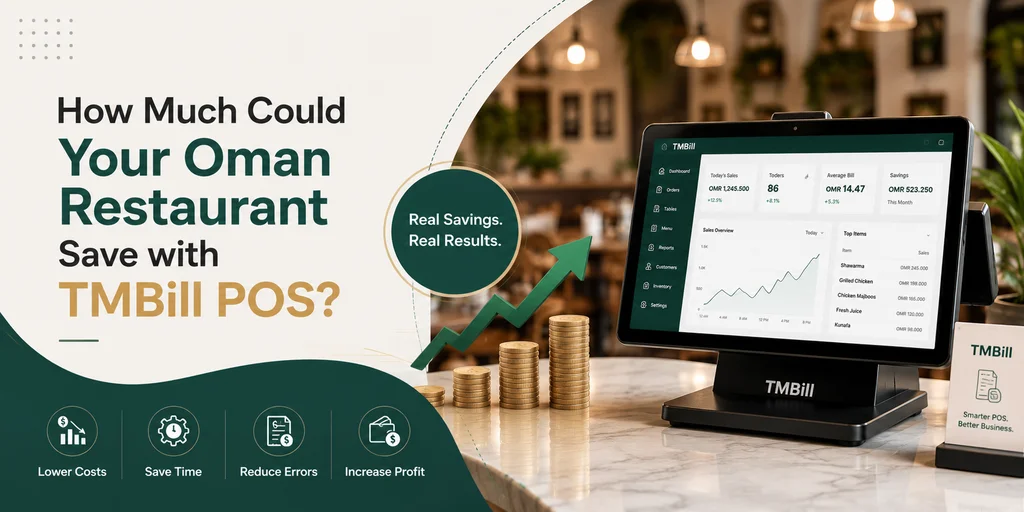
Most restaurants in Oman lose four to five percent of monthly revenue to billing errors, stock waste, and manual admin time without realising it. For a mid-size restaurant turning over OMR 20,000 a month, that is roughly OMR 900 lost every month. TMBill restaurant POS software typically recovers OMR 400 to 700 of that through accurate billing, real-time stock tracking, and offline reliability, which works out to OMR 4,800 to 8,400 a year for a single outlet, and considerably more for a multi-branch group. The exact saving depends on the outlet size, current loss rate, and how many branches are involved.
KEY TAKEAWAYS
- Restaurants in Oman typically lose four to five percent of monthly revenue to billing errors, stock waste, and manual admin time.
- TMBill recovers a meaningful share of that loss through accurate billing, real-time stock tracking, and offline reliability during internet outages.
- Small cafes can save OMR 2,160 to 3,600 a year, mid-size restaurants OMR 4,800 to 8,400, and three-branch groups OMR 14,400 to 24,000.
- Most restaurants recover the cost of TMBill within three to six months.
- Savings compound faster for multi-outlet groups, since the same error and waste rates apply across every branch at once.
Where is your Oman restaurant actually losing money?
Most restaurant owners in Oman can point to slow service or a quiet night, but the steady, invisible losses come from somewhere else: mistyped bills, missed items, ingredients that expire before anyone notices, and staff time spent reconciling the till by hand. Industry estimates suggest billing errors, stock shrinkage, and untracked wastage alone can cost a restaurant three to four percent of annual turnover (source: TMBill), and that figure climbs higher once manual admin time and missed supplier orders are added in.
Oman's foodservice sector is also growing quickly, expected to rise from USD 1.63 billion in 2025 to close to USD 1.89 billion in 2026, which means more transactions, more menu items, and more room for small errors to add up across a busy month. A restaurant still running on a manual till, a basic cash register, or a spreadsheet for stock is not just slower day to day, it is quietly leaking margin that never shows up as a single, obvious loss.
This is exactly why choosing the right restaurant POS system in Oman matters more than most owners initially assume. The features that look like conveniences, accurate billing, kitchen order tickets, and stock alerts, are the same features that stop money from leaking out unnoticed.
How much could your restaurant save? A look by outlet size
The table below breaks down typical monthly loss and the estimated saving TMBill recovers, based on restaurant size in Oman. Actual figures vary by current systems, menu complexity, and staff processes, but the ranges reflect what most restaurants experience after switching from manual billing or a basic till.
| Restaurant profile | Est. monthly revenue | Typical loss from errors, waste & admin | Est. monthly saving with TMBill | Est. annual saving |
|---|---|---|---|---|
| Small cafe or single till | OMR 6,000 – 9,000 | OMR 300 – 450 (4–5%) | OMR 180 – 300 | OMR 2,160 – 3,600 |
| Mid-size restaurant, one outlet | OMR 15,000 – 25,000 | OMR 600 – 1,100 (4–5%) | OMR 400 – 700 | OMR 4,800 – 8,400 |
| Multi-outlet group, 3 branches | OMR 45,000 – 70,000 | OMR 1,800 – 3,000 (4–5%) | OMR 1,200 – 2,000 | OMR 14,400 – 24,000 |
Note: Figures are indicative estimates based on typical error and waste rates for restaurants operating without an integrated POS. Kays IT can build a more precise estimate for your outlet during a free consultation.
How does TMBill turn into real savings?
Each of TMBill's core features maps directly to one of the loss areas above. None of them are complicated, but together they close most of the gap between what a restaurant earns and what it actually keeps.
- Accurate billing: automatic pricing, tax calculation, and itemised bills remove the manual entry mistakes that cause under-billing or disputed charges, which is usually the fastest saving a restaurant sees after going live.
- Real-time stock tracking: recipe-level inventory management for restaurants in Oman flags low stock and expiring items before they turn into waste, which is typically the single largest saving category for restaurants moving off manual stock counts.
- Offline reliability: Pacific POS keeps billing and kitchen tickets running during an internet outage, so a dropped connection never becomes a lost sale or a night of handwritten receipts to reconcile later.
- Centralised reporting: multi-outlet restaurant groups save additional staff hours that used to go into manually consolidating each branch's numbers into one report.
- Fewer kitchen errors: digital kitchen order tickets cut down on mis-heard or mis-written orders that lead to remakes and wasted ingredients, which quietly adds up across a busy service.
A quick example: what this looks like for a Muscat restaurant
Take a mid-size, single-outlet restaurant in Muscat turning over roughly OMR 20,000 a month on a manual till and a paper-based kitchen order system. Before TMBill, the owner is losing an estimated OMR 900 a month to a mix of billing mistakes, small stock write-offs, and time spent reconciling the till and consolidating supplier orders by hand.
After moving to TMBill, accurate billing and automatic VAT invoicing close most of the billing-error gap within the first month. Real-time stock tracking then starts flagging ingredients before they expire, cutting waste over the following two to three months as staff adjust ordering habits. By month three, the restaurant is typically recovering OMR 400 to 700 a month, which covers the setup cost and moves into pure saving from that point forward.
What could your restaurant recover?
Get a free savings estimate for your restaurant. The Kays IT team in Muscat can build a precise figure for your outlet, in English or Arabic.
of monthly revenue lost to errors, waste & admin
Do savings scale for multi-outlet restaurant groups?
Yes, and often faster than owners expect. A three-branch group in Oman applies the same four to five percent loss rate across a combined monthly revenue of OMR 45,000 to 70,000, which works out to OMR 1,800 to 3,000 in monthly loss before TMBill, and an estimated OMR 1,200 to 2,000 recovered each month once billing, stock, and reporting are centralised. Over a year, that is OMR 14,400 to 24,000 back in the business, on top of the time saved by no longer consolidating branch reports by hand.
The centralised dashboard also means a manager can spot a branch that is losing more than the others, whether that is higher wastage, more voided bills, or slower kitchen turnaround, and address it directly instead of discovering the pattern months later in a year-end review.
How long does it take to pay back the cost of TMBill?
Because TMBill is priced with a one-time setup and licence fee rather than an ongoing per-outlet subscription, most restaurants in Oman recover the cost within three to six months once staff are trained and the system is fully configured. Multi-outlet groups often see a faster payback since the same savings apply across every branch from day one. After the initial payback period, the monthly saving becomes close to pure margin recovered from losses that were previously going unnoticed.
The exact number depends on your outlet size, current loss rate, and how many branches you run, but the pattern holds across almost every restaurant in Oman: money is quietly leaking through billing errors, stock waste, and manual admin, and it is recoverable with the right system in place.
Frequently asked questions
How much could a small restaurant in Oman save with TMBill?
A small cafe or single-till restaurant in Oman typically loses four to five percent of monthly revenue to billing errors, stock waste, and manual admin time. On a monthly revenue of OMR 6,000 to 9,000, that is roughly OMR 300 to 450 lost every month, of which TMBill typically recovers OMR 180 to 300, or around OMR 2,160 to 3,600 a year.
What is the payback period for TMBill POS in Oman?
Most restaurants in Oman recover the cost of TMBill within three to six months, depending on outlet size and how much of the loss was coming from billing errors and stock shrinkage. Multi-outlet groups often see a faster payback because the savings compound across every branch at once.
Does TMBill save money on stock and food waste?
Yes. TMBill tracks recipe-level ingredient usage and stock levels in real time, so managers can see what is about to run low or expire before it becomes wasted stock. This is usually the single biggest saving for restaurants moving off manual stock counts or a spreadsheet.
How does offline billing reduce lost revenue?
When the internet drops, a restaurant on a cloud-only system either stops billing or reverts to handwritten tickets, both of which lose sales and create reconciliation errors later. TMBill's Pacific POS mode keeps billing, printing, and reporting running offline, so a network outage in Oman does not translate into lost revenue for the night.
Do multi-outlet restaurant groups save more with TMBill?
Yes, proportionally. A three-branch group in Oman can lose OMR 1,800 to 3,000 a month across all outlets combined to the same errors and waste that affect a single restaurant, and centralised reporting also removes the manual work of consolidating each branch's numbers by hand, which adds further time savings on top of the direct cost recovery.
What ongoing costs affect TMBill's ROI?
TMBill is typically priced with a one-time setup and licence fee plus a modest annual support cost, so the ongoing cost is predictable and low compared to per-outlet subscription platforms. This keeps the return on investment stable year over year rather than eroding as a restaurant adds outlets or staff.
Is TMBill worth it for a small cafe in Oman?
Yes. Even at OMR 180 to 300 in monthly savings, a small cafe typically covers the cost of TMBill within the first two to three quarters, after which the ongoing saving is close to pure margin recovered from errors and waste that were previously invisible on a manual till.
How quickly can a restaurant start seeing savings after installing TMBill?
Most restaurants see a visible drop in billing errors and clearer stock reporting within the first two to four weeks of going live, once staff are trained and the menu and recipes are fully configured. Full savings typically show up from the second month onward as reporting data builds up.