
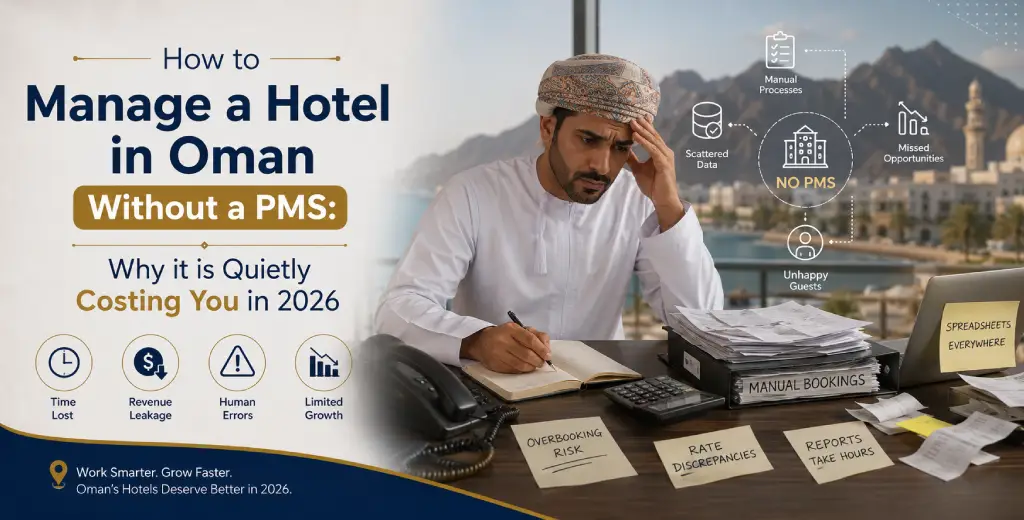
You can run a hotel in Oman without a PMS, a hotel management system, by handling check-ins on paper, tracking rooms on a whiteboard, and reconciling the day’s takings in a spreadsheet after midnight. Thousands of properties across Muscat, Salalah, and Sohar still do exactly that. The problem is not that it is impossible. The problem is that the manual method leaks money every single day, through billing errors, double bookings, idle rooms, and hours of staff time you never get back. This guide walks through what that daily chaos actually looks like, what it costs in real OMR terms, and how to tell whether your property has quietly outgrown its manual habits.
What does running a hotel without a hotel management system actually look like?
Picture a normal morning at a 40-room property in Muscat. The night auditor has left a stack of handwritten registration cards. The front desk is matching them against a paper booking diary, a separate Booking.com inbox, and a WhatsApp thread where the owner forwarded three direct enquiries last night. Housekeeping is working from a printed room list that was accurate at 7 a.m. and is already wrong by 9.
Nobody is being careless. Everybody is busy. But the property is being run from at least four disconnected sources of truth, and none of them talk to each other. That gap, between what the system thinks is happening and what is actually happening on the floor, is exactly where the cost lives. Every manual hotel runs on the assumption that staff will catch the mismatches before guests do. Most days they almost do. The days they don’t are the expensive ones.
A day in the life of a manually-run Oman hotel
Walk through a single shift and the leaks become obvious:
- 7:00 a.m.: Night audit totals are added up by hand. A late-night F&B charge from Room 214 was written on a notepad that has since gone missing. That charge is now gone forever.
- 9:30 a.m.: An early guest arrives. The desk checks them into Room 108, not knowing housekeeping hasn’t serviced it yet. The guest opens the door to an unmade room.
- 12:00 p.m.: A room sold on an OTA at 11 p.m. last night still shows ‘available’ in the diary. The desk takes a walk-in for the same room. One of these two guests will be walked.
- 6:00 p.m.: The owner asks how occupancy looked this week. Nobody can answer precisely. The reply is a guess.
- 11:00 p.m.: The receptionist spends 40 minutes reconciling cash against handwritten bills. It’s OMR 14 short. Nobody knows why.
None of these moments triggers an alarm. None of them produces an invoice you can see. And that is precisely why they are so dangerous; the cost of running without a system is invisible until you add it all up.
Why manual check-in and check-out cost more than time
Manual front desk work feels free because no one charges you for it. But every guest interaction handled by hand carries a hidden cost:
- A check-in that takes 8–10 minutes on paper instead of 2–3 minutes digitally creates queues during peak arrival hours, the first impression guests remember and review.
- Registration details copied by hand introduce typos in names, ID numbers, and contact details, which then break your folio, your tax records, and any chance of marketing to that guest again.
- At check-out, staff manually total room nights; F&B charges; laundry; and minibar from separate notebooks. Anything missed is revenue that walks straight out the door.
For a property running 65% occupancy, even one missed charge of OMR 8–12 per occupied room per week adds up to several hundred rials a year, untracked, unrecovered, and entirely avoidable.
How much revenue do billing errors and overbooking really cost?
This is where manual management gets expensive fast. Without a single connected system, two failures repeat constantly.
Billing errors. Charges get missed, discounts get applied twice, and VAT gets calculated by hand and entered wrong. Each mistake is small. Across thousands of transactions a year, they compound into a real gap between the revenue you earned and the revenue you actually collected.
Overbooking and rate mismatches. When availability is updated by hand across your diary, Booking.com, Expedia, and your own phone line, lag is inevitable. A room sold online at 11 p.m. is still ‘available’ in your book the next morning. The result is either a walked guest, with compensation costs and a damaging review, or a room left empty because the diary said it was taken. This is the single most common failure in Oman hospitality, and we covered exactly how it happens in why Oman hotels are losing bookings every day.
For a 50-room hotel in Muscat at 65% occupancy, a single walked guest during high season can cost OMR 40–80 in compensation and rebooking before you count the long-term review damage. Multiply that across a peak Khareef month in Salalah, and the figure stops being a rounding error.
Download our free Hotel Operations Efficiency Guide!
A practical checklist that maps exactly where your property is losing time and revenue this month, and what to fix first. No cost, no obligation.
What happens when housekeeping and the front desk don’t talk?
In a manual operation, housekeeping status lives on a clipboard, and front desk status lives in a diary. When those two fall out of sync, which is constant, you get the two worst outcomes in hospitality:
Selling a dirty room. The front desk checks an early arrival into a room housekeeping has not yet cleaned. The guest walks into a mess, and your rating takes the hit.
Holding a clean room empty. A room is ready, but the desk doesn’t know, so a tired guest waits in the lobby while a serviced, sellable room sits idle.
Neither costs you a visible line on a spreadsheet. Both cost you guest trust, online ratings, and repeat business, the things that actually drive an Oman property’s long-term occupancy. In a market where guests compare every hotel on Booking.com and Google before arriving, a handful of ‘room wasn’t ready’ reviews can quietly suppress your conversion for months.
Why “we’ll check the numbers later” never works without reporting
Ask an owner running a hotel manually how the property performed last Tuesday, and you usually get a guess. Without an integrated hotel management system, there is no reliable Average Daily Rate (ADR), no real RevPAR, no segment breakdown of where bookings came from, and no clean VAT-ready summary at month end.
That means decisions get made on instinct instead of data:
- You can’t see that mid-week occupancy is quietly slipping until a whole quarter has gone.
- You can’t tell which OTA delivers profitable guests versus high-commission, low-value ones, which makes it impossible to plan a real direct-booking strategy like the one outlined in how Omani hotels can increase direct bookings.
- You can’t prove your numbers cleanly at VAT filing time, so the accountant’s workload and your audit risk both grow.
Oman’s tourism sector is expanding under the Vision 2040 push, with steady corporate demand in Muscat and seasonal surges in Salalah. The properties that win that growth are the ones that can see their performance clearly and react within days, not the ones flying blind on monthly guesswork.
The real cost, added up
Take a deliberately conservative view for a single 50-room property in Oman running on manual processes:
| Hidden cost source | Conservative annual estimate |
|---|---|
| Missed charges and billing errors | OMR 1,500 to 3,000 |
| Overbooking compensation and walked guests | OMR 1,000 to 2,500 |
| Staff hours lost to manual reconciliation | 15 to 20 hours / week |
| Empty rooms from sync lag during peak season | Often the largest, and hardest to measure |
Why hotels delay switching, and why the delay is the expensive part
Most owners don’t stay manual because they think it’s better. They stay manual because change feels risky: fear of disruption during the switch, worry that staff won’t adapt, uncertainty about cost, and the assumption that ‘we’ve always managed.’ Each of those concerns is reasonable. None of them is as expensive as another full year of leaks. The longer a property waits, the more peak seasons pass with revenue quietly draining away, and peak season is precisely when manual systems break hardest.
What a hotel management system changes
A hotel management system, commonly called a hotel PMS (Property Management System): replaces the diary, the clipboards, the spreadsheets, and the scattered inboxes with one connected platform. Front desk, housekeeping, billing, and reporting all share the same live information, so:
- Check-in and check-out are fast and accurate, with every charge captured automatically.
- Housekeeping status updates in real time, visible to the front desk instantly.
- VAT-compliant invoices generate correctly every time.
- Availability syncs across your OTAs and direct website, so overbooking stops, the foundation of the smart booking technology that drives higher occupancy.
- You get real reporting, ADR, RevPAR, occupancy, and revenue at a glance.
For Oman properties specifically, the system that makes sense is cloud-based, works in Arabic and English, handles local VAT, connects cleanly to a hotel channel manager for OTA distribution, and, critically, is supported locally rather than by a remote overseas helpdesk. If you’re researching options, a good starting point is a modern hotel management system in Oman that brings booking, billing, housekeeping, and reporting into one place with on-the-ground support.
You don’t need to fix everything at once. But you do need to see clearly where the leaks are before another peak season slips past.
Book a free, No-obligation Demo!
See where your hotel is leaking revenue. Book a free, no-obligation demo of our hotel management system and watch your front desk, billing, housekeeping, and reporting work as one.
Frequently Asked Questions
1. Do I really need a hotel management system for a small hotel in Oman?
Yes, and small properties often benefit most. With fewer staff, manual errors and double bookings hit harder because there’s no slack to absorb them. A cloud-based hotel management system handles front desk, billing, and OTA sync automatically, freeing your small team to focus on guests instead of paperwork and late-night reconciliation.
2. What is the difference between a hotel PMS and a hotel management system?
They usually mean the same thing. ‘Hotel management system’ is the everyday term; ‘PMS’ (Property Management System) is the industry term. Both describe software that manages reservations, check-in and check-out, housekeeping, billing, and reporting from one connected platform, replacing manual diaries and disconnected spreadsheets.
3. How much does running a hotel without a PMS actually cost?
There’s no single bill, which is what makes it dangerous. Costs hide in missed charges, overbooking compensation, empty rooms from sync lag, and staff hours lost to manual work. For a 50-room Oman property, these commonly add up to several thousand rials a year before counting lost repeat business from poor guest experiences and bad reviews.
4. Will a hotel management system work if my internet connection drops?
Modern systems are built for this. Cloud-based platforms with an offline mode continue processing check-ins, billing, and core operations when connectivity drops, then sync automatically once it returns. This matters in parts of Oman where connectivity can be intermittent, so ask any vendor specifically how their offline handling works before deciding.
5. Does a hotel management system handle Oman VAT requirements?
A good one does. It should generate compliant tax invoices automatically, apply the correct VAT rate, and produce clean month-end summaries for filing. This removes a major source of manual error and reduces audit risk; always confirm VAT readiness and local compliance support before choosing any hotel management system in Oman.
6. How long does it take to switch from manual processes to a PMS?
For most small to mid-size Oman hotels, implementation typically runs a few weeks: system setup and configuration, importing existing data, staff training, and a supported go-live. The key is choosing a provider that offers local, on-site support during the switch, so daily operations are not disrupted while your team learns the new system.
7. Can a hotel management system connect to Booking.com and other OTAs?
Yes, usually through an integrated or connected channel manager. This syncs availability and rates across all your OTAs and your direct website in real time, which is the single most effective way to stop the overbooking and rate-mismatch problems that manual management creates.
8. Won’t my front desk staff struggle to learn new software?
This is the most common fear and the least justified. Modern hotel management systems are designed for non-technical hospitality staff, and a good local provider includes hands-on training during go-live. Most teams are comfortable within days, and reception staff are usually the first to appreciate the time it saves them every shift.