
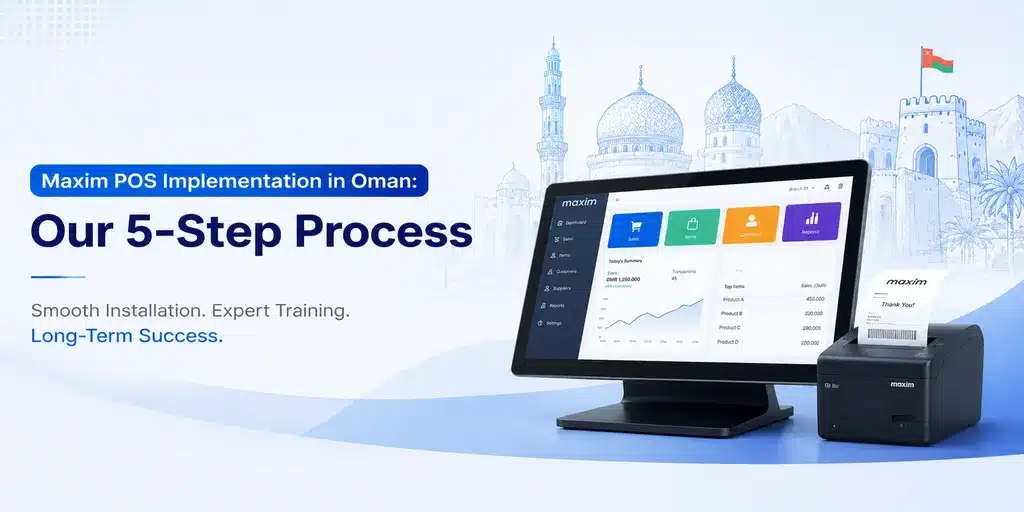
Maxim POS implementation in Oman follows a clear five-step process: site survey, hardware setup, data migration, staff training, and go-live support. For a typical single-store retailer in Oman, the full rollout takes 5 to 10 working days from the first survey to going live. Kays IT manages every step on-site with a local Muscat-based engineering team, so your staff is never left to work the system out alone. This guide walks through exactly what happens at each stage, how long each one takes, and how we make sure your team is confident before the first live transaction.
If you have already decided that Maxim is the right fit but you are still hesitating, the reason is almost always one of two questions: how long will this take? And will my team actually cope with it? This article answers both in full.
Key takeaways
Maxim POS is implemented in Oman through a five-step process: site survey, hardware setup, data migration, staff training, and go-live support.
A single retail store in Oman is typically live within 3 to 5 working days; a mid-size supermarket within 5 to 7 working days.
Hardware setup, configuration, and data migration are completed before go-live, so the changeover does not interrupt trading hours.
Kays IT is a Muscat-based IT provider with 18 years of experience and runs every step on-site with local phone and WhatsApp support afterward.
Maxim POS includes an offline mode and is built for Oman’s 5% VAT invoicing rules.
Why retailers in Oman delay switching their POS system
Most supermarket and retail owners in Oman do not delay because of price. They delay because they picture the worst case: the till goes down during a busy Friday evening, staff stand around confused, customers walk out, and a full day of sales is lost while a technician sits on a phone line somewhere overseas.
That fear is reasonable when you buy from a remote-only vendor. It is not how a Maxim retail POS system in Oman is deployed by Kays IT. Every implementation is run by a local engineer who is physically in your store, and the changeover is scheduled around your trading hours, not against them. The five steps below are designed to remove disruption, not create it.
Step 1: Site survey and needs assessment
Every Maxim POS implementation in Oman begins with a free site survey. A Kays IT engineer visits your store in Muscat, Salalah, Sohar, or wherever you operate and assesses the practical reality of your setup rather than guessing from a brochure.
During the survey, we record:
- The number of checkout counters you run and where they sit on the floor
- Your existing hardware (cash drawers, scanners, printers, weighing scales) and whether any of it can be reused
- Your network and internet stability, which matters for cloud sync and offline mode
- Your product range, supplier list, and how you currently price and label stock
- Your VAT setup and reporting needs under Oman’s 5% VAT rules, administered by the Oman Tax Authority
The output of this step is a written implementation plan with a fixed timeline and a clear hardware list. There are no surprises later because the scope is agreed upon before any equipment arrives. The survey usually takes a few hours for a single store and a half-day for a multi-counter supermarket.
Step 2: Hardware setup and configuration
Once the plan is approved, our team prepares and installs the hardware. Where you already own compatible equipment, we connect and test it. Where you need new units, Kays IT supplies and services them locally, so you are never waiting weeks for a part to clear customs.
This stage covers:
- Installing and connecting POS terminals, barcode scanners, receipt printers, and cash drawers
- Configuring Maxim POS with your store details, tax rates, and payment methods
- Setting up user roles and permissions so cashiers, supervisors, and managers each see only what they should
- Activating offline mode, so billing continues even if your internet drops, with automatic sync once it returns
- Testing every counter end to end before a single real sale is processed
Because the configuration is done before go-live, your team walks into a system that is already tailored to how your store works.
Step 3: Data migration
This is the step most retailers worry about, because their entire product catalogue and pricing live inside their old system. Losing that, or re-entering thousands of items by hand, is a real fear.
Kays IT migrates your data for you. We import your product list, barcodes, categories, prices, supplier records, and, where possible, your customer database directly into Maxim POS. Items are checked for duplicates and pricing errors during the import, which often means you start with a cleaner catalogue than you had before.
For a store with a few thousand SKUs, data migration typically takes one to two working days. You review and approve the imported data before go-live, so nothing goes live until you have confirmed it is correct.
Worried about moving your product catalogue to a new POS?
Our team can review your current system and confirm what products, prices, suppliers, and customer records can be migrated before you commit to switching.
Request a Free Migration Assessment
Step 4: Staff training
A POS system is only as good as the team using it. This is where the “will my team cope?” question is answered directly.
Kays IT delivers hands-on training on-site, in your store, on your actual hardware, not over a video call. Sessions are run in the language your staff is comfortable with, including Arabic, and they are kept practical:
- Cashiers learn billing, returns, discounts, split payments, and end-of-shift cash reconciliation
- Supervisors learn voids, price overrides, and shift handovers
- Managers learn inventory control, purchase orders, VAT reports, and the daily and monthly sales dashboards
Training is built around real scenarios your staff will face, such as a customer disputing a price or a busy queue at peak hour. We also provide a quick-reference guide, so cashiers have something to glance at in the first few days. Most retail teams in Oman are comfortable with the basics within a single training session.
Step 5: Go-live support
On go-live day, a Kays IT engineer is physically present in your store. We do not hand you the keys and leave. The engineer is on the floor for the first live trading period, watching real transactions, answering questions on the spot, and fixing any small issues before it becomes a problem.
To avoid disruption, go-live is usually scheduled for a quieter trading window or after the previous system’s busy period, so your team eases into it rather than being thrown in during a Friday rush. After the on-site day, you move on to Kays IT’s ongoing local support, with a Muscat-based team you can reach by phone or WhatsApp, not a ticket queue in another time zone.
How long does Maxim POS implementation take in Oman?
Here is a realistic timeline for the most common store types. Your written plan from Step 1 will confirm the exact dates for your business.
| Store type | Survey | Hardware + config | Data migration | Total |
|---|---|---|---|---|
| Single small retail shop | Half day | 1 day | 1 day | 3 to 4 working days |
| Mid-size supermarket | 1 day | 2 days | 1 to 2 days | 5 to 7 working days |
| Multi-branch retailer | 1 to 2 days | 2 to 3 days/branch | 2 to 3 days | 2 to 4 weeks (full rollout) |
The point to take away: a typical single store in Oman is live within a working week, and the parts of the process that could disrupt trading are completed before you ever switch over.
Will my team cope with the new system?
Yes, and the reason is the order of the steps. Your staff is not asked to learn anything until the system is fully configured for your store, your data is already loaded, and a trainer is standing next to them. They practice on a system that already looks like your business. Then, on the first real day, an engineer is there to support them.
If you are still comparing options, our guide to the best POS systems for supermarkets in Oman puts Maxim side by side with the alternatives, and our explainer on what a POS system is and how it works for Oman retailers covers the fundamentals if you are newer to the category.
Book your free site survey
Book your free site survey with a Kays IT engineer today, and we will give you a written implementation plan, a hardware list, and a fixed go-live date with no obligation.
Frequently asked questions
How long does Maxim POS implementation take in Oman?
A typical single store is fully live within 3 to 5 working days, and a mid-size supermarket within 5 to 7 working days. Multi-branch rollouts run 2 to 4 weeks depending on the number of locations. Your exact timeline is confirmed in a written plan after the free site survey, so there are no surprises.
Will my old product data be lost when I switch to Maxim POS?
No. Kays IT migrates your product list, barcodes, prices, categories, and supplier records into Maxim POS for you. Data is checked for duplicates and pricing errors during import, and you review and approve everything before go-live. You do not need to re-enter your catalogue by hand.
Do you provide training in Arabic?
Yes. Staff training is delivered on-site in the language your team is comfortable with, including Arabic. Sessions are hands-on, run on your actual hardware, and built around the real situations cashiers and managers face daily, such as returns, discounts, and end-of-shift reconciliation.
Will switching to Maxim POS disrupt my store’s trading hours?
No. Hardware setup, configuration, and data migration are completed before go-live, so trading continues as normal during preparation. Go-live is scheduled for a quieter trading window, and a Kays IT engineer is present on the floor for the first live period to handle any issue immediately.
Can I keep my existing POS hardware?
In many cases, yes. During the site survey, our engineer checks whether your current scanners, printers, cash drawers, and scales are compatible with Maxim POS. Compatible equipment is reused to reduce cost. Where new hardware is needed, Kays IT supplies and services it locally in Oman.
What support do I get after go-live?
After the on-site go-live day, you move on to Kays IT’s ongoing local support. You reach a Muscat-based team directly by phone or WhatsApp, rather than an overseas helpdesk. This means faster response times and support staff who understand Oman VAT rules and local retail conditions.
Does Maxim POS work without internet in Oman?
Yes. Maxim POS has an offline mode that keeps processing sales, billing, and inventory updates when your connection drops. Data syncs automatically once connectivity returns. This is configured and tested during setup, which matters for stores in areas of Oman with intermittent connectivity.