
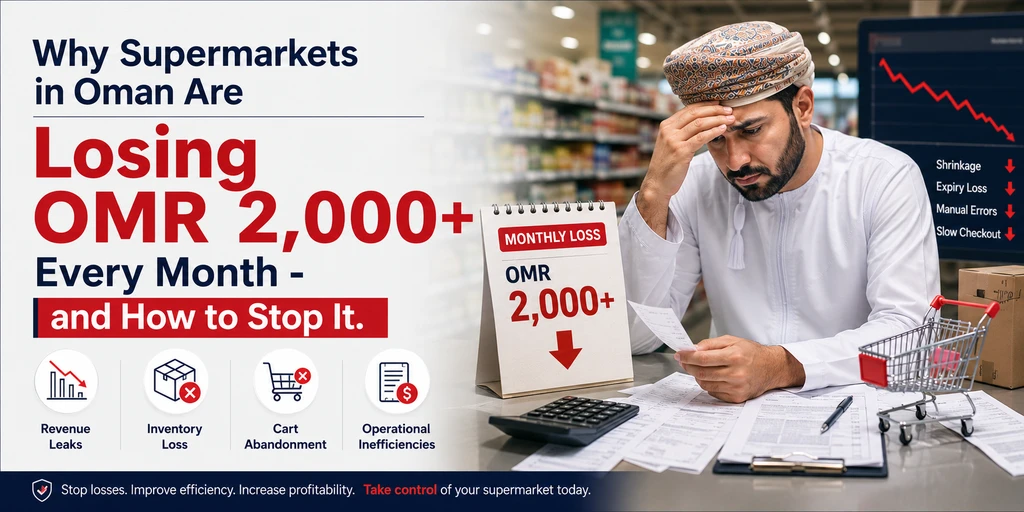
Most supermarkets and grocery stores in Oman are losing between OMR 2,000 and OMR 5,000 every month, not because of theft alone, but because of billing errors, untracked stock shrinkage, and pricing mistakes that go unnoticed until it is too late. These losses are invisible on a day-to-day basis, but they compound fast. The fix is not more staff or tighter manual checks. It is automation through a modern retail POS system. This guide breaks down exactly where the money is going and how Oman supermarkets can stop the bleed starting this week by using the Maxim POS system.
The Hidden Cost of Running a Supermarket on Manual Processes
Walk into almost any independent supermarket in Muscat, Salalah, or Sohar and you will find the same scene: a cashier entering prices by hand, a stockroom tracked on a printed sheet updated once a week, and end-of-day cash counts that rarely match the register total. Every one of those gaps is money leaving the business.
Oman’s retail sector is growing fast. VAT compliance requirements have tightened. Customer expectations around pricing accuracy and speed have risen. Yet many grocery and supermarket operators are still running on processes that were designed for a different era and paying for it every single month.
Where Exactly Is the Money Going? The 4 Sources of Silent Loss
1. Manual Billing Errors at the Checkout
This is the most common and most underestimated source of loss. When prices are entered manually, or when barcodes are not scanned correctly, the errors go in both directions. Some items are undercharged, some are overcharged, and most discrepancies are never caught. A single cashier making just two pricing errors per hour across a 12-hour shift can generate 24 wrong transactions per day. At an average error value of OMR 0.500 per transaction, that is OMR 12 lost per cashier per day, or OMR 360 per month per till. A three-till supermarket is already looking at over OMR 1,000 per month from billing errors alone.
2. Stock Shrinkage and Inventory Gaps
Shrinkage, the difference between what you bought and what you sold, is one of the most persistent challenges in Oman retail. It comes from three main sources: supplier short delivery, staff pilferage, and customer shoplifting. Without real-time inventory tracking, you will not know a product is missing until the shelf is empty, or a stocktake reveals a gap weeks later.
The average shrinkage rate for grocery and supermarket retail globally sits between 1.5% and 2% of revenue. For an Oman supermarket turning over OMR 50,000 per month, that is OMR 750 to OMR 1,000 in stock losses every month that simply disappears without trace.
3. Pricing Mistakes and Promotion Errors
During promotions, Ramadan offers, National Day discounts, and weekly specials, manual price updates across hundreds of SKUs create a minefield of pricing inconsistencies. Staff apply discounts to the wrong items. Old prices stay in the system after a promotion ends. Customers are charged at the wrong rate. Each pricing mistake either costs the business margin or triggers a customer complaint that damages trust.
One missed price update on a promotional item selling 80 units per day at an OMR 0.200 margin error costs OMR 16 per day, OMR 480 over a 30-day promotion period. Multiply that across five promotional lines running simultaneously, and the loss is significant.
4. End-of-Day Cash Reconciliation Losses
Cash mismatches at the end of shifts are so routine in manually operated supermarkets that many owners have simply accepted them as unavoidable. They are not. When there is no audit trail linking each transaction to a specific cashier, tracking a shortfall is nearly impossible. Small, consistent shortfalls, OMR 10 here, OMR 20 there, add up to OMR 300 to OMR 600 per month of unaccounted losses.
💸 Quick Cost Summary: Where Oman Supermarkets Are Losing Money Each Month
Billing errors (3 tills): OMR 1,000, 1,500
Stock shrinkage (1.5–2% of revenue): OMR 750, 1,000
Pricing and promotion errors: OMR 300, 800
Cash reconciliation gaps: OMR 300, 600
─────────────────────────────────────────────────────
Estimated total monthly loss: OMR 2,350, 3,900
Stop Losing OMR 2,000+ Every Month!
Book a free Maxim POS demo with a Kays IT specialist in Oman.
The VAT Compliance Risk That Most Supermarkets Are Not Talking About
Since Oman introduced VAT in April 2021, every retail transaction must be recorded and reported accurately. Manual billing systems and basic cash registers are not designed to handle the specifics of Oman’s VAT framework, zero-rated food items, standard-rated non-food products, and the documentation requirements for VAT returns.
If your supermarket issues an incorrect VAT invoice or fails to keep adequate records, you are exposed to penalties from the Oman Tax Authority. Non-compliance fines can range from OMR 1,000 to OMR 10,000 depending on the severity and frequency of the error. A modern POS system that is built for Oman’s VAT requirements removes this risk entirely by automating the calculation, recording, and reporting of every VAT-liable transaction.
For a full breakdown of what your billing system must do to remain VAT-compliant in Oman, see the dedicated Kays IT guide to VAT-ready retail POS systems for Oman.
Why More Staff Does Not Solve the Problem
The instinctive response to billing errors and stock loss is to add more people, another cashier, a dedicated stockroom supervisor, and a second person checking end-of-day cash. This feels like control. It is not.
More staff doing manual work produces more manual errors. It also adds payroll cost to the existing loss. The problem is not the people; it is the process. Manual systems have an inherent error rate that cannot be trained. The only solution is to remove manual data entry from the equation entirely.
How Automation Stops the Loss: What a Modern Retail POS System Does
This is the second half of the story, and the part that changes the numbers.
A purpose-built retail POS system for Oman supermarkets replaces manual entry with barcode scanning, automates inventory updates in real time, and generates a complete audit trail for every transaction. Here is what that means in practice:
- Billing errors drop to near-zero: Every item is scanned and pulled from the product database. There is no manual price entry.
- Inventory updates automatically: Every sale reduces stock in real time. Low-stock alerts trigger before a product runs out, not after.
- Promotions apply instantly and accurately: Set the promotion date range once, and the system applies and removes the discount automatically.
- End-of-day cash reconciliation is automatic: Every transaction is logged, timestamped, and linked to a specific cashier. Shortfalls are identified immediately.
- VAT invoices are generated correctly every time: Oman-compliant VAT calculations are built in, and zero-rated and standard-rated items are handled automatically.
- Multi-branch visibility: If you operate in more than one location, you can see sales, stock, and performance across all branches from a single dashboard.
Maxim POS: The Retail POS System Built for Oman Supermarkets
The Maxim Retail POS System is the most widely used retail management platform for supermarkets, grocery stores, and multi-branch retail operations in Oman. It is supplied and supported locally by Kays IT, Oman’s longest-established technology partner with over 20 years serving the Sultanate.
Maxim POS is built to handle the specific requirements of Oman retail, Arabic interface, VAT compliance, offline mode for areas with intermittent connectivity, and hardware that is sold, installed, and serviced by Kays IT’s local team in Muscat. There are no overseas helpdesks, no language barriers, and no delays waiting for a support call back from a different time zone.
What Maxim POS Does That Generic Systems Cannot
- Works offline – keeps processing sales when your internet connection drops, then syncs automatically when connectivity resumes
- Arabic interface – fully localised for Oman retail environments, usable by Arabic-speaking cashiers and supervisors without translation
- Oman VAT-compliant – calculates, records, and reports VAT correctly from day one with no manual configuration required
- Real-time multi-branch dashboard – see every branch’s sales, stock, and performance from a single screen
- Barcode label printing – print product labels directly from the system for new stock arrivals
- Staff accountability – every transaction is linked to a named cashier with a complete audit trail
Download: Free POS Readiness Brochure!
Find out if your supermarket is ready to switch to a modern POS system. Download the free Brochure; no email required.
Download a Maxim POS Brochure →
What the Switch Looks Like: From Manual to Automated in 5 Steps
The biggest concern most supermarket owners in Oman raise is disruption. ‘Will I have to close the store?‘ ‘How long will it take?‘ ‘Will my staff cope?‘ The answer to all three: no, not long, and yes.
Kays IT’s implementation process is designed around operational continuity. Here is what the transition looks like:
- Site survey – A Kays IT engineer visits your store, maps the checkout layout, and specifies the hardware required.
- Hardware setup – POS terminals, barcode scanners, receipt printers, and cash drawers are installed and configured.
- Data migration – Your existing product list, pricing, and stock levels are imported into Maxim POS.
- Staff training – Kays IT trains your cashiers and supervisors on-site. Most staff are operational within one session.
- Go-live and support – Kays IT is on-site for your first live trading day. Ongoing support is a phone call or WhatsApp away.
The entire process from site survey to go-live typically takes less than a week for a single branch supermarket. Many Kays IT clients are live within 3 to 4 days.
Book a Free Maxim POS Demo!
See exactly how Maxim POS eliminates billing errors and stock loss in a live walkthrough. No commitment, no sales pressure, just 30 minutes with a Kays IT specialist.
Frequently Asked Questions
Everything Oman supermarket owners and retail managers need to know about billing errors, stock loss, and retail POS systems.
1. How much are billing errors actually costing my supermarket in Oman?
For a supermarket with two to three checkout tills operating on manual price entry, billing errors typically cost between OMR 600 and OMR 1,500 per month. This figure combines undercharged items, overcharged customers (who may not complain but do not return), and end-of-day cash mismatches that cannot be traced back to a specific transaction. A barcode-scanning POS system eliminates manual entry and brings this cost to near zero within the first month of operation.
2. Does Maxim POS work without an internet connection in Oman?
Yes. Maxim POS has a built-in offline mode that continues processing sales, billing, inventory updates, and receipt printing when your internet connection drops. All data syncs automatically once connectivity is restored. This is particularly important for supermarkets in areas of Oman with intermittent connectivity, and for any retail business that cannot afford to stop trading during a network outage.
3. Is Maxim POS compliant with Oman’s VAT requirements?
Yes. Maxim POS is built to meet Oman Tax Authority requirements for retail invoicing. It correctly identifies zero-rated food items and standard-rated non-food items, generates VAT-compliant receipts, and produces the transaction records needed for VAT returns. This removes the manual calculation burden from your cashiers and significantly reduces your compliance risk.
4. How long does it take to install a POS system in an Oman supermarket?
For a single-branch supermarket, Kays IT’s standard implementation timeline is three to five working days from site survey to go-live. This covers hardware installation, product data migration, system configuration, and staff training. Implementation is planned around your trading hours; Kays IT typically completes hardware work after store closing to avoid disrupting live operations.
5. Can Maxim POS manage multiple supermarket branches across Oman?
Yes. Maxim POS supports multi-branch retail operations, with a centralised dashboard that gives you real-time visibility of sales, stock levels, and performance across all locations from a single login. Pricing, promotions, and product updates can be pushed from head office to all branches simultaneously, eliminating the risk of branch-level pricing discrepancies.
6. What is the difference between stock shrinkage and billing errors in Oman retail?
Billing errors occur at the point of sale: wrong prices are entered, discounts are applied incorrectly, or items are not scanned. Stock shrinkage refers to the gap between what was purchased from suppliers and what was actually sold, caused by supplier short delivery, staff pilferage, shoplifting, or spoilage. A POS system with real-time inventory tracking addresses both: billing errors are eliminated by barcode scanning, and shrinkage is detected early through automated stock-level monitoring and variance reporting.
7. How does a retail POS system help with Ramadan and seasonal promotions in Oman?
A POS system allows you to set up promotional prices in advance with defined start and end dates. During Ramadan or National Day promotions, discounts apply automatically at the checkout without cashier intervention and are removed automatically when the promotion ends. This eliminates the pricing errors that commonly occur when promotions are managed manually and ensures your promotional margins are protected.
8. How do I get started with Maxim POS for my supermarket in Oman?
Contact Kays IT through kaysit.com/maxim-retail-pos-system-oman/ to schedule a free site survey and demo. A Kays IT specialist will visit your store, assess your current setup, and provide a recommendation and quote within 48 hours. There is no obligation; the site survey and demo are completely free.