
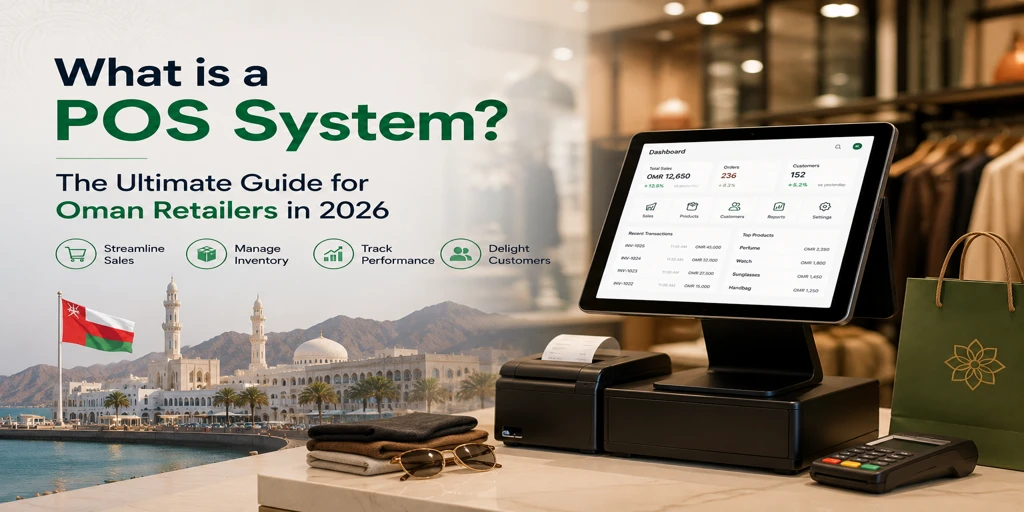
What is a POS System?
A POS system — Point of Sale system — is the software and hardware that processes every sale your business makes. It records the transaction, updates your stock, prints or sends the receipt, calculates VAT, and stores the data so you can review your sales at any time. In short, it is the central nervous system of any modern retail or food and beverage business in Oman.
If you are still using a basic cash register, a manual billing book, or a disconnected spreadsheet to run your supermarket, grocery store, or retail shop, this guide is for you. We will explain exactly what a POS system does, how it differs from what you are currently using, and what to look for when choosing one in Oman in 2026.
Cash Register vs. POS System: What is the Difference?
This is the question most Oman retailers ask first. Both accept payments. That is where the similarity ends.
| Feature | Basic Cash Register | Modern POS System |
|---|---|---|
| Records sales | Yes — amount only | Yes — item, quantity, price, time, cashier |
| Inventory tracking | No | Yes — auto-deducts stock per sale |
| VAT invoicing | Manual or none | Automatic — VAT-compliant invoice per transaction |
| Barcode scanning | Rarely | Yes — standard on all modern POS systems |
| Sales reports | No | Daily, weekly, monthly — by product, cashier, or category |
| Multi-branch management | No | Yes — view all stores from one dashboard |
| Loyalty programmes | No | Yes — points, discounts, member pricing |
| Works offline | Yes | Yes — modern POS systems include offline mode |
The real difference is intelligence. A cash register records that money moved. A POS system records what sold, how much of it you still have, who served the customer, and when peak sales happen – automatically, in real time, without any extra work from your team.
Is your retail store ready for a POS system?
Book a free 30-minute demo with a Kays IT specialist. We will show you Maxim POS running live and answer every question specific to your business in Oman.
How Does a POS System Work? Step by Step
Understanding the mechanics helps you see why a POS system changes operations so fundamentally. Here is what happens from the moment a customer brings an item to your checkout counter.
Step 1 — Item scanning
The cashier scans the item barcode using a handheld or countertop barcode scanner. The POS system reads the barcode, identifies the product in its database, pulls the current price, and displays it on the cashier screen and the customer-facing display — all in under one second.
For weighted items like meat, cheese, or vegetables sold by the kilogram, the POS connects to your weighing scale. The weight is read automatically, and the price is calculated without any manual entry. This eliminates one of the most common billing errors in Oman supermarkets.
Step 2 — Cart total and promotions
As each item is scanned, the running total updates on screen. Any active promotions — buy two get one free, percentage discount on a product category, loyalty member pricing — are applied automatically. The cashier does not need to remember any of this. The system handles it.
Step 3 — Payment processing
The customer chooses their payment method: cash, debit or credit card, or digital wallet. The POS system records the payment method alongside the transaction. Cash payments show the cashier exactly how much change to give. Card payments can be integrated with your payment terminal so the amount transfers directly without the cashier re-entering it manually.
Step 4 — VAT-compliant receipt
The moment payment is confirmed, the POS generates a VAT-compliant receipt showing the itemized bill, the VAT amount (5% as per Oman’s VAT regulations), the store name, the transaction reference number, and the date and time. This happens automatically — no manual VAT calculation, no risk of a non-compliant invoice.
Receipts can be printed via a connected thermal printer, sent by SMS, or emailed — depending on the customer’s preference.
Step 5 — Inventory auto-update
Behind the scenes, the moment that sale is completed, the POS system deducts every sold item from your stock count. If you sold three units of a product, your inventory now shows three fewer units. If that product drops below your preset minimum stock level, the system generates a low-stock alert so you can reorder before shelves go empty.
This is what makes a POS system transformative for Oman supermarkets and retail stores. You no longer need a separate team doing manual stocktakes. Your inventory is accurate, in real time, after every single sale.
Real-world example
A supermarket in Muscat previously did a full stocktake every Friday — four staff members, six hours, manually counting every item on every shelf. After implementing Maxim POS, their system inventory matched physical stock within 0.3% accuracy at all times. The Friday stocktake was replaced by a 10-minute digital report.
Key Features of a POS System for Oman Retailers
Not all POS systems are the same. Here are the features that matter specifically for retailers operating in Oman.
1. Barcode scanning and weighing scale integration
Every POS system for a supermarket or grocery store must support barcode scanning. Look for a system that also integrates directly with weighing scales for fresh produce, deli counters, and bakery items. Manual weight entry is slow and error-prone — the integration eliminates both problems.
2. Oman VAT compliance
Since Oman introduced VAT at 5% in April 2021, every retail business is required to issue VAT-compliant tax invoices. Your POS system must automatically calculate and display VAT on every receipt, generate VAT summary reports for your accountant, and store transaction records in a format acceptable for Oman Tax Authority audits. A system that is not built for Oman’s VAT structure creates compliance risk.
3. Real-time inventory management
The POS should track your stock in real time across every product and category. You should be able to set reorder points for each item, so the system alerts you when stock runs low. Advanced systems support purchase order generation — the POS creates a reorder request to your supplier automatically when a product hits the minimum threshold.
4. Multi-branch management
If you operate more than one store — whether in Muscat, Salalah, Sohar, or Nizwa — your POS system should give you a single dashboard showing sales, stock levels, and performance for every branch simultaneously. You should be able to transfer stock between branches, compare revenue across locations, and see which products perform differently in different cities.
5. Offline mode
Internet connectivity in Oman is generally reliable, but there are moments — during a power fluctuation, a router issue, or in areas with weaker connectivity — where the connection drops. Your POS must continue functioning offline, processing sales, and storing transactions locally. When the connection restores, everything syncs automatically. A POS that stops working when the internet goes down is a business risk you cannot afford during a busy Friday shopping rush.
6. Customer loyalty programmes
Loyalty programmes drive repeat visits, which are the most profitable type of customer in retail. A modern POS system manages loyalty points automatically — the customer gives their phone number; the system looks up their account, applies their discount or adds their earned points, and updates their balance. No separate loyalty card, no separate system, no manual record-keeping.
7. Sales reporting and analytics
The data your POS captures every day is one of the most valuable assets your business has. You should be able to see your top-selling products by category and time period, your slowest-moving items, your busiest hours, your best-performing cashiers, your daily and monthly revenue trends, and your gross margin per product. This data tells you where to invest, what to stop stocking, and when to run promotions.
Which Businesses in Oman Need a POS System?
Any business in Oman that sells products or services directly to customers can benefit from a POS system. The most common are:
- Supermarkets and grocery stores – The highest-volume users of POS in Oman, where checkout speed, stock accuracy, and VAT compliance are daily priorities.
- Pharmacies – Need medicine expiry tracking, controlled-item records, and precise VAT invoicing on pharmaceutical products.
- Restaurants and cafés – Need table management, kitchen order routing, split billing, and real-time inventory on ingredients.
- Fashion and apparel stores – Need size/colour variant management, seasonal promotions, and customer purchase history.
- Electronics retailers – Need serialized inventory (tracking by serial number), warranty management, and supplier returns.
- Petrol station forecourt shops – Need integration with fuel dispensers alongside a standard retail POS for the shop side.
- Multi-branch retail chains – Any retailer with two or more outlets across Oman needs centralised control that only a POS system provides.
Cloud-Based POS vs On-Premises POS: Which is right for Oman?
This is a common question for first-time buyers. The answer depends on your business size and preferences.
For most supermarkets, grocery stores, and retail businesses in Oman, a cloud-based POS with a reliable offline mode is the better choice. Lower upfront cost, automatic updates, and access from anywhere — including the ability for a business owner to check their sales figures from home or while travelling — make cloud POS the practical choice in 2026.
| Cloud-Based POS | On-Premise POS | |
|---|---|---|
| Data storage | Stored securely on remote servers | Stored on your local hardware |
| Access | From any device, anywhere | Only on-site computers |
| Updates | Automatic — no IT effort needed | Manual — requires IT team |
| Internet dependency | Required (offline mode handles outages) | No internet needed |
| Cost | Monthly subscription — lower upfront | Higher upfront hardware/software cost |
| Best for | Most Oman retail businesses | Large enterprises with specific IT needs |
Maxim POS: The Leading POS System for Oman Retailers
Maxim POS is Oman’s most trusted retail POS system, used by supermarkets, grocery chains, pharmacies, and multi-branch retail stores across Muscat, Salalah, Sohar, Nizwa, and beyond. It is developed for the specific requirements of Oman retail, including 5% VAT compliance, an Arabic language interface, offline mode, and integration with local payment gateways.
What makes Maxim POS different for Oman businesses
- VAT-ready billing: Automatically generates Oman Tax Authority-compliant invoices on every transaction.
- Offline mode: Continues processing sales without internet – data syncs when connection restores.
- Weighing scale integration: Connects to your existing scales for automatic weight-based pricing on fresh items.
- Multi-branch dashboard: View all your Oman stores from a single login – inventory, sales, and staff performance.
- Local support: Kays IT is based in Wattayah, Muscat—on-site support is available across Oman.
- Arabic interface: Full Arabic language support for cashier screens and customer-facing displays.
- Loyalty programme built-in: Customer CRM, points tracking, and member pricing – no third-party tool needed.
See Maxim POS in action — book your free demo today!
Speak with a Kays IT specialist who understands Oman retail. We will show you a live walkthrough of Maxim POS configured for your specific type of business — supermarket, pharmacy, grocery, or multi-branch retail.
How to Choose the Right POS System for Your Oman Business
With many options available in the market, here is a straightforward checklist for evaluating any POS system before you commit.
| Question to ask | Why it matters |
|---|---|
| Is it Oman VAT-compliant? | Non-compliant invoices create legal and audit risk under Oman’s VAT law |
| Does it have offline mode? | Essential for business continuity during connectivity issues |
| Is there local support in Oman? | Remote-only support from overseas means long delays when something breaks |
| Can it handle my specific inventory type? | Weighted items, serialized products, and variants all need specific capabilities |
| Does it support multi-branch management? | Critical if you have or plan to have more than one location |
| What are the total costs — hardware, software, training? | Understand the full 12-month cost before comparing options |
| How long does implementation take? | Some systems take days, others take weeks — important for planning |
| Is there an Arabic interface? | Important for Omani staff who are more comfortable working in Arabic |
Final Thoughts
A POS system is not a luxury for large supermarket chains. In 2026, it is the operational foundation every retail business in Oman—large or small—needs to manage inventory accurately, comply with VAT regulations, serve customers faster, and make decisions based on real data instead of gut feel.
The difference between a business running on a basic cash register and one running on a modern POS system is not just efficiency. It is the difference between operating blind and operating with full visibility of every sale, every product, and every trend in your business.
If you are ready to see what a POS system looks like in practice for your Oman retail business, the next step is simple.
Frequently Asked Questions
1. What is a POS system in simple terms?
A POS system (Point of Sale system) is the software that processes your sales, tracks your stock, and generates your receipts. Every time a customer buys something in your store, the POS records the transaction, deducts the items from your inventory, calculates VAT, and prints or sends the receipt — all automatically. Think of it as a smart cash register that also manages your entire business operations.
2. Do small shops in Oman need a POS system?
Yes. Even a single-counter grocery store or small retail shop in Oman benefits from a POS system. VAT compliance is required by law for registered businesses, and a POS ensures every receipt is compliant. Beyond compliance, the real-time stock tracking and daily sales reports give small shop owners visibility they simply cannot get from a basic cash register or manual book.
3. Is a POS system required by Oman law?
A POS system itself is not legally mandated, but issuing VAT-compliant tax invoices is required for all VAT-registered businesses in Oman under the VAT law enforced by the Oman Tax Authority. A proper POS system is the most reliable way to ensure every transaction generates a compliant invoice automatically, without the risk of human error in manual billing.
4. How much does a POS system cost in Oman?
POS system costs in Oman vary depending on the hardware, software, and number of checkout counters. A basic single-counter setup typically includes the software subscription, a barcode scanner, a receipt printer, and a cash drawer. Cloud-based systems like Maxim POS use a monthly subscription model, which is significantly lower in upfront cost than on-premise alternatives. Contact Kays IT for a quote specific to your store size and requirements.
5. Can a POS system work without internet in Oman?
Yes. Modern POS systems like Maxim POS include an offline mode that continues processing transactions, printing receipts, and tracking sales when the internet connection drops. All data is stored locally and syncs automatically once the connection is restored. This is particularly important for retail stores in areas of Oman where connectivity can be intermittent.
6. How long does it take to set up a POS system in Oman?
For a typical supermarket or retail store in Oman, a POS system can be fully installed and operational within three to five working days. This includes hardware installation, software configuration, product database setup, staff training, and a go-live day with technical support on-site. Kays IT provides end-to-end implementation support across Muscat and other cities in Oman.
7. What hardware do I need for a POS system in Oman?
A standard POS setup for an Oman retail store typically includes a touchscreen monitor or tablet, a barcode scanner, a receipt printer, a cash drawer, and a customer-facing display. Supermarkets also add weighing scales that connect directly to the POS. Kays IT supplies and services all compatible hardware in Oman, so you get everything from a single provider with local support.
8. What is the best POS system for supermarkets in Oman?
Maxim POS is the most widely used POS system for supermarkets and retail stores in Oman. It is built for Oman’s VAT requirements, supports Arabic language interfaces, integrates with weighing scales, offers multi-branch management, and is supported locally by Kays IT based in Muscat. Book a free demo at kaysit.com/maxim-retail-pos-system-oman/ to see it in action for your specific business.