
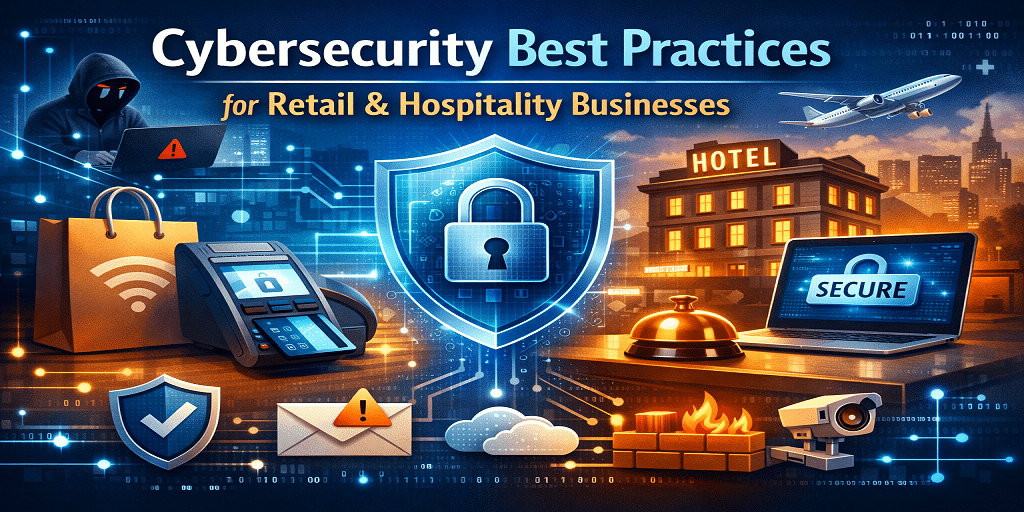
Retail stores, restaurants, hotels, and service-based businesses across Oman are becoming increasingly dependent on digital systems. From POS terminals and booking engines to cloud-based management platforms, technology now powers daily operations.
However, as digital adoption grows, so does cyber risk.
Retail and hospitality businesses are among the most targeted sectors globally due to their high transaction volumes, customer data storage, and interconnected systems. In Oman, where digital transformation is accelerating, many small and mid-sized businesses are still underprepared for modern cyber threats.
With Oman accelerating its Oman Vision 2040 digital transformation strategy, businesses across retail and hospitality are rapidly adopting cloud-based systems. However, increased connectivity without structured cybersecurity planning significantly increases overall exposure to cyber threats.
Understanding and implementing Cybersecurity Best Practices is no longer optional; it is essential for business continuity, regulatory compliance, and brand reputation.
This guide outlines practical, actionable cybersecurity strategies tailored specifically for retail and hospitality businesses in Oman.
Why Retail & Hospitality Businesses Are Prime Cyber Targets
Retail and hospitality businesses face unique security vulnerabilities:
- High volumes of card transactions
- Customer databases containing personal information
- Multiple connected systems (PMS, POS, accounting, booking platforms)
- Public Wi-Fi networks
- Third-party vendor integrations
- Seasonal staffing with varying access levels
Hotels store passport details, payment credentials, and guest preferences. Retail outlets manage daily financial transactions and inventory systems. Restaurants operate POS systems integrated with payment gateways.
Every digital touchpoint is a potential entry point for cybercriminals.
Attackers often target small and mid-sized businesses because they assume defenses are weaker compared to large enterprises.
Most Common Cyber Threats in 2026
Before implementing protection strategies, it is important to understand the most common threats affecting businesses in Oman's retail and hospitality sectors.
1. POS Malware Attacks
Malware targeting POS terminals can capture credit card information during transactions. These attacks often go unnoticed until financial losses occur.
2. Ransomware
Ransomware encrypts business data and demands payment to restore access. For hotels and retailers, even a few hours of downtime can result in significant revenue loss.
3. Phishing & Social Engineering
Employees may unknowingly click on malicious links, granting attackers access to internal systems.
4. Insider Threats
Former employees or untrained staff with excessive access permissions can pose risks.
5. Weak Network Security
Unsecured Wi-Fi networks, outdated routers, and poorly configured firewalls create vulnerabilities.
Understanding these risks helps businesses implement preventive cybersecurity measures rather than reacting to incidents after damage occurs.
Core Cybersecurity Best Practices for Retail & Hospitality Businesses
1. Secure POS and Payment Infrastructure
POS systems are among the most vulnerable components in retail and hospitality environments.
Businesses using a retail pos system oman must ensure that payment data is encrypted, systems are PCI-compliant, and terminals are isolated from general office networks.
Similarly, smaller establishments operating a POS system for small business Oman should not assume limited scale means limited risk. Even small stores are frequent targets because attackers view them as easier entry points.
Best practices include:
- End-to-end encryption
- Secure payment gateways
- Regular security patches
- Strong password policies
- Network segmentation
Securing the POS infrastructure protects both customer data and financial integrity. Businesses integrating POS platforms with accounting systems should also ensure secure configurations and encrypted data transfer. If you are planning to connect both systems, read our guide on how to integrate POS and accounting software in Oman to avoid common security gaps.
2. Protect Hotel Management Systems & Guest Data
Hotel systems manage reservations, guest records, billing, and internal reporting. If compromised, they expose sensitive data and disrupt operations.
Businesses operating hotel management software in Oman must prioritize:
- Role-based access controls
- Multi-factor authentication
- Encrypted data storage
- Regular vulnerability assessments
Many independent hotels look for cost-effective solutions and may choose an affordable hotel PMS Oman, but affordability should never come at the expense of security. A secure PMS must include strong authentication protocols and regular system updates.
Guest trust depends heavily on data protection. A single breach can damage a hotel's reputation permanently.
3. Implement Multi-Factor Authentication (MFA)
Passwords alone are no longer sufficient.
Multi-factor authentication adds an extra security layer by requiring:
- One-time passcodes
- Authentication apps
- Biometric verification
MFA significantly reduces unauthorized access even if login credentials are compromised.
All critical systems, including POS dashboards, PMS platforms, email accounts, and cloud services, should require MFA.
4. Keep Software and Systems Updated
Outdated software is one of the most common security vulnerabilities.
Retail and hospitality businesses must:
- Enable automatic updates
- Regularly patch operating systems
- Update antivirus definitions
- Replace unsupported hardware
Cybercriminals often exploit known vulnerabilities in outdated systems. Proactive patch management reduces exposure to such threats.
5. Network Segmentation
Many businesses make the mistake of running all systems on a single network.
Best practice involves dividing networks into separate segments:
- Guest Wi-Fi
- POS systems
- Administrative systems
- CCTV and IoT devices
This prevents attackers from moving laterally across systems if one network is compromised.
6. Employee Cybersecurity Awareness Training
Technology alone cannot prevent cyber incidents.
Employees must understand:
- How to identify phishing emails
- Safe password practices
- Risks of using unsecured USB devices
- Importance of logging out of shared systems
Retail and hospitality businesses often experience high staff turnover, making regular training essential.
Human error remains one of the largest cybersecurity risks.
7. Data Backup & Disaster Recovery Planning
Even with strong security, incidents can occur.
A reliable backup strategy includes:
- Daily automated backups
- Cloud-based redundancy
- Offsite storage
- Regular restoration testing
Disaster recovery planning ensures operations resume quickly after cyber incidents, minimizing downtime and revenue loss.
8. 24/7 Monitoring & Professional IT Support
Cyber threats do not operate on business hours.
Continuous monitoring helps detect unusual activity before damage escalates. Many businesses in Oman lack in-house IT teams capable of round-the-clock surveillance.
Through Offshore staffing solutions in Oman, companies can leverage remote IT professionals to monitor networks, respond to alerts, and manage security systems efficiently without expanding internal payroll costs.
This approach provides cost-effective access to specialized cybersecurity expertise.
Compliance & Data Protection Responsibilities in Oman
Retailers and hospitality operators must recognize their responsibility to protect customer information.
Failure to secure data can result in:
- Financial penalties
- Legal disputes
- Payment processor restrictions
- Reputational damage
Payment security standards require encrypted transactions and secure storage practices. Even beyond legal compliance, ethical responsibility toward customer data is crucial for long-term trust.
Customers increasingly prefer businesses that demonstrate a strong commitment to digital security.
The Cost of Ignoring Cybersecurity
Some business owners view cybersecurity as an optional expense.
However, the real cost of neglecting security includes:
- Revenue loss due to system downtime
- Ransom payments
- Legal liabilities
- Customer compensation
- Brand damage
- Operational disruptions
For hotels, a system outage during peak season can lead to lost bookings and negative reviews. For retailers, compromised POS systems can result in chargebacks and payment processor suspension.
Cybersecurity investment is not merely defensive — it is strategic risk management.
Building a Cybersecurity Roadmap for 2026
Cybersecurity is not a one-time implementation — it is an ongoing strategic framework. Retail and hospitality businesses in Oman must adopt a structured, phased roadmap to protect operations while supporting digital growth.
Here is a practical, executive-level approach for 2026.
Step 1: Conduct a Comprehensive Security Audit
Start with a full assessment of your current IT infrastructure.
Evaluate:
- POS system security
- PMS access controls
- Network configurations
- Firewall setup
- Wi-Fi segmentation
- Cloud storage protection
- Backup policies
- Employee access privileges
This audit should identify vulnerabilities, outdated systems, and compliance gaps. Many businesses discover that old routers, shared admin logins, or inactive user accounts pose hidden risks.
A structured vulnerability assessment provides a measurable baseline.
Step 2: Identify and Prioritize Critical Assets
Not all systems carry equal risk.
Classify digital assets into tiers:
Tier 1 – Mission Critical
POS systems, PMS platforms, booking engines, payment gateways
Tier 2 – Operational Systems
Inventory systems, HR software, payroll platforms
Tier 3 – Support Systems
Marketing tools, reporting dashboards
By prioritizing protection around revenue-generating systems first, businesses minimize operational disruption risks.
Step 3: Implement Layered Security (Defense-in-Depth)
Modern cybersecurity requires multiple layers of protection.
A layered security approach should include:
- Firewalls and intrusion detection systems
- Endpoint protection software
- Multi-factor authentication
- Email filtering systems
- Encrypted payment processing
- Network segmentation
- Role-based access control
If one layer fails, another prevents full compromise.
This dramatically reduces breach probability.
Step 4: Establish Clear Access Control Policies
Retail and hospitality environments often have:
- Front desk staff
- Cashiers
- Seasonal employees
- Supervisors
- IT administrators
Each role should have limited, role-specific access.
Best practices include:
- Principle of least privilege
- Automatic deactivation of former employee accounts
- Unique login credentials (no shared passwords)
- Quarterly access reviews
Access governance prevents both accidental and malicious misuse.
Step 5: Develop an Incident Response Plan
Many businesses invest in prevention but neglect response planning.
A documented incident response plan should define:
- Who identifies and reports incidents
- Who isolates affected systems
- Who communicates with stakeholders
- Backup activation procedures
- External IT escalation process
The faster the response, the lower the damage.
Even a 2-hour response delay can significantly increase financial impact.
Step 6: Invest in Continuous Monitoring & Threat Detection
Cyber threats evolve constantly.
Businesses should move beyond reactive security and adopt:
- Real-time log monitoring
- Suspicious activity alerts
- Automated threat detection
- Routine penetration testing
Continuous monitoring reduces dwell time — the period attackers remain undetected in your systems.
Lower dwell time equals lower damage.
Step 7: Strengthen Employee Security Culture
Technology alone cannot secure a business.
Leadership must foster a culture where:
- Employees verify suspicious emails
- Staff report unusual system behavior
- Password hygiene is enforced
- Security training occurs quarterly
Retail and hospitality businesses in Oman often hire temporary or rotating staff. Structured onboarding security training is essential.
A security-aware workforce becomes your strongest defense layer.
Step 8: Budget for Cybersecurity as a Strategic Investment
Cybersecurity should be part of annual financial planning.
Allocate budget for:
- System upgrades
- Professional IT services
- Security audits
- Monitoring tools
- Backup solutions
- Staff training
Treat cybersecurity as infrastructure — not an emergency expense.
Proactive investment always costs less than post-breach recovery.
Step 9: Review and Improve Quarterly
A roadmap is not static.
Schedule quarterly reviews to:
- Assess new threats
- Evaluate system performance
- Test backup restoration
- Update access permissions
- Review compliance standards
Cybersecurity maturity improves over time through continuous refinement.
Why This Roadmap Matters for 2026 and Beyond
Retail and hospitality in Oman are entering a highly digitized era. Cloud systems, mobile payments, AI integrations, and omnichannel platforms are increasing efficiency — but also expanding attack surfaces.
Businesses that implement a structured cybersecurity roadmap will:
- Reduce financial risk
- Maintain operational continuity
- Strengthen brand trust
- Improve compliance posture
- Gain a competitive advantage
Cybersecurity is no longer just IT protection.
It is a business resilience strategy.
Conclusion: Protecting Growth Through Smart Security
As Oman's retail and hospitality sectors continue to grow, digital transformation will remain central to operational success. However, growth without security creates vulnerability.
From POS terminals and hotel management systems to cloud platforms and customer databases, every digital asset must be protected through structured cybersecurity strategies. Implementing strong authentication, encrypted transactions, network segmentation, employee training, and continuous monitoring ensures businesses stay resilient in an evolving threat landscape.
Cybersecurity is no longer a technical concern — it is a leadership responsibility.
If your retail store, hotel, or restaurant has not conducted a cybersecurity assessment in the past 12 months, now is the time to evaluate system vulnerabilities and implement a structured protection strategy. Businesses that prioritize protection today will build stronger, more trusted brands tomorrow.
Secure Your Business Before Threats Strike
Protect your retail or hospitality business with expert-driven cybersecurity solutions tailored for Oman.
👉 Request a Cybersecurity Consultation.
Frequently Asked Questions
1. Why are retail and hospitality businesses frequent cyberattack targets?
Retailers and hotels process high volumes of payment transactions and store sensitive customer information. Their interconnected systems, public Wi-Fi networks, and multiple third-party integrations create numerous entry points, making them attractive targets for cybercriminals seeking financial data and operational disruption.
2. How can small businesses improve cybersecurity without a large IT team?
Small businesses can implement basic protections such as multi-factor authentication, encrypted payment systems, regular updates, employee training, and network segmentation. Partnering with professional IT service providers also enables continuous monitoring and expert guidance without maintaining a full in-house cybersecurity team.
3. What is the biggest cybersecurity risk in hospitality operations?
The most significant risk is unauthorized access to guest data through unsecured PMS systems or compromised staff credentials. Phishing attacks and weak password practices often create vulnerabilities that allow attackers to infiltrate hotel systems and access sensitive information.
4. How often should businesses conduct cybersecurity audits?
Businesses should conduct comprehensive security audits at least once annually, with periodic vulnerability scans and risk assessments throughout the year. Regular monitoring ensures systems remain protected against evolving threats and newly discovered software vulnerabilities.
5. What happens if a business ignores cybersecurity measures?
Ignoring cybersecurity can lead to financial losses, operational downtime, legal consequences, reputational damage, and loss of customer trust. Recovery from a data breach is often significantly more expensive than investing in preventive security measures.